
Contact Information
Office: WEL: 5.320
Phone: 471-5053
Lab
Office:
Phone:
Fax: 471-8615
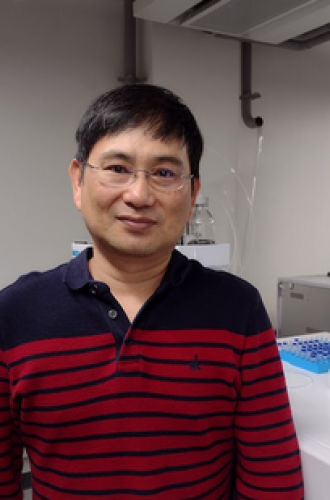
Brent L. Iverson
biverson@mail.utexas.edu
University Distinguished Teaching Professor, Faculty
Warren J. and Viola Mae Raymer Professorship
 |
Research Group
Iverson Labs |
Education
BS, Stanford University, 1982 PhD, California Institute of Technology, 1987
Postdoctorate, Scripps Research Institute (1987-90)
|
|
Affiliations
Beckman Center for the Design and Fabrication of Sensor Arrays;
Center for Nano- and Molecular Science and Technology;
Institute for Cellular and Molecular Biology;
The production, characterization, and manipulation of large, functional molecules from three different points of view
Antibody and Enzyme Engineering with an emphasis on developing better methods for recombinant antibody or enzyme cloning and directed evolution. In collaboration with the Georgiou group (UT Chemical Engineering) several new technologies have been developed based on E. coli expression / FACS selection which have allowed us to enhance antibody affinity to remarkable levels, as well as quantitatively analyze the protein evolution process with an unprecedented level of precision. Several important antibodies have been developed including one currently being evaluated as a therapeutic prophylactic/intervention for anthrax infection. We have recently extended the work to include manipulation of enzyme catalysts.
Artificial macromolecules with defined higher order structure and function These systems involve the predictable folding of synthetic molecules into stable scaffolds, based on abiotic secondary structure elements. Our first generation molecules, called aedamers , fold in aqueous solution due to the stacking of alternating electron rich and electron deficient aromatic units. We have expanded this work to include a novel intermolecular recognition motif in water as well as applications to liquid crystals.
The chemistry of nucleic acid binding, recognition and modification with a primary focus on understanding and exploiting our newly created polyintercalating molecules. These molecules show sequence specificity, are amenable to combinatorial techniques and some derivatives are active against gram positive bacteria. We have recently used high filed NMR to determine the structure of the first threading tetraintercalator bound to its preferred site in double stranded DNA.
Representative Publications
Gabriel, G. J., Sorey, S., Iverson, B. L. "Altering the Folding Patterns of Naphthyl Trimers" J. Am. Chem. Soc. 127 (2005): 2637-2640.
Varadarajan, N., Gam, J., Olsen M.J., Georgiou, G., and Iverson, B.L. "Engineering of Protease Variants Exhibiting High Catalytic Activity and Exquisite Substrate Selectivity" Proc. Nat. Acad. Of Sci, USA 102 (2005): 6855-6860.
Harvey, B.R., Georgiou, G., Hayhurst, A., Jeong, K-J., Iverson, B.L. and Rogers, G.K. "Anchored Periplasmic Expression, a Versatile Technology for the Isolation of High Affinity Antibodies from E. coli Expressed Libraries" Proc. Nat. Acad. Of Sci, USA 101 (2004): 9193-9196.
Lee, J., Guelev, V., Sorey, S., Hoffman, D., and Iverson, B.L. "NMR Structural Analysis of a Modular Threading Tetraintercalator" J. of Am. Chem. Soc. 126 (2004): 14036-14042.
Mao, C., Solis, D., Reiss, B.D., Kottman, S.T., Sweeney, R.Y., Hayhurst, A., Georgiou, G., Iverson, B.L., and Belcher, A.M. "Virus-Based Toolkit for the Directed Synthesis of Magnetic and Semiconducting Nanowires" Science 303 (2004): 213-217.
Mazor Y, Van Blarcom T, Mabry R, Iverson BL, Georgiou G. "Isolation of engineered, full-length antibodies from libraries expressed in Escherichia coli" Nat Biotechnol. 25(5) (2007): 563-565.
Chu Y, Sorey S, Hoffman DW, Iverson BL. "Structural characterization of a rigidified threading bisintercalator" J. Am. Chem. Soc. 129(5) (2007): 1304-1311.
Reczek, Joseph J., Villazor, Karen R., Lynch, Vincent, Swager, Timothy M.,Iverson, Brent L. "Tunable Columnar Mesophases Utilizing C2 Symmetric Aromatic Donor-Acceptor Complexes" J. Am. Chem. Soc. 128 (2006): 2637-2640.
Bradford, V.J. and Iverson, B.L. "Amyloid-like Behavior in Abiotic, Amphiphilic Foldamers" J. Am. Chem. Soc. 130(1) (2008): 1517-1524.