
Sun Sun


Department of Chemistry & Biochemistry
The University of Texas at Austin
1 University Station A5300
Austin, TX 78712-0165


Contact Information


Office: WEL: 3.148
Phone: 471-4575

Lab


Office:
Phone:
Fax: 471-8696

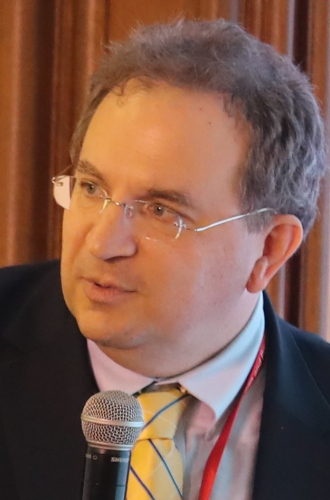
Dmitrii E. Makarov


makarov@mail.utexas.edu
Associate Professor, Faculty


Research Group


Makarov Group

Education


PhD, Institute of Chemical Physics, Moscow, 1992
BS, Moscow Institute of Physics and Technology, 1990


Affiliations


Center for Computational Biology and Bioinformatics; Institute for Cellular and Molecular Biology; Center for Nano- and Molecular Science and Technology; Institute for Computational and Engineering Sciences; Institute for Theoretical Chemistry; Texas Materials Institute;

Theory and computer simulation of the dynamics of biomolecules


Single molecule dynamics

Our work in single molecules theory is motivated by the recent developments in scanning tunneling microscopy, atomic force microscopy, and single molecule optical spectroscopy, which enable experimenters to observe and manipulate individual molecules. For example, by monitoring fluorescence, one photon at a time, from a dye molecule planted on a single protein, one can record a "movie" of the protein's dynamics. Understanding the information contained in such a "movie" requires theoretical insight into the relationship between the emission process and the molecule's dynamics. Our research involves the development and use of simulation methods in order to study quantum dynamics of single molecules and to understand how these dynamics are manifested in the properties of the molecules' emission.

Mechanical properties of single protein molecules

Some proteins have load-bearing functions in living organisms and are unique materials. We use atomistic simulations as well as simple theoretical models to study the mechanical resistance of individual protein molecules subject to stretching forces. Our goal here is to understand the atomic force microscopy pulling experiments performed on single proteins and to learn how the mechanical properties of proteins depend on their structure.

Protein translocation

Protein translocation across certain membranes and protein degradation by ATP-dependent proteases involve the threading of proteins though narrow pores whose dimensions cannot accommodate folded domains. We are using computer simulations to understand these processes at the molecular level. This work is done in close collaboration with experimentalists and, besides simulations, involves development of new computational methods for estimating entropies and equilibrium constants from molecular dynamics or Monte Carlo data.


Representative Publications


Dmitrii E. Makarov "Computer simulations and theory of protein translocation" Accounts of Chemical Research 42 (2009): 281-289.

Dmitrii E. Makarov "A theoretical model for the mechanical unfolding of repeat proteins" Biophysical Journal 96 (2009): 2160.

Dmitrii E. Makarov and Kevin W. Plaxco "Measuring the dimensions of unfolded biopolymers using FRET: The effect of polymer chain dynamics on the observed FRET efficiency" Journal of Chemical Physics 131 (2009): 085105.

Serdal Kirmizialtin and Dmitrii E. Makarov "Simulations of the untying of molecular friction knots between individual polymer strands" J. Chem. Phys. 128 (2008): 094901.

Lei Huang and Dmitrii E. Makarov "The rate constant of polymer reversal inside a pore" J. Chem. Phys. 128 (2008): 114903.

Reza Soheilifard, Dmitrii E. Makarov, and Gregory J. Rodin "Critical evaluation of simple network models of protein dynamics and their comparison with crystallographic B-factors" Physical Biology 5 (2008): 026008.

Ryan R. Cheng, Takanori Uzawa, Kevin W Plaxco, and Dmitrii E. Makarov "The rate of intramolecular loop formation in DNA and polypeptides: The absence of the diffusion-controlled limit and fractional power law viscosity dependence" Journal of Physical Chemistry B (): .