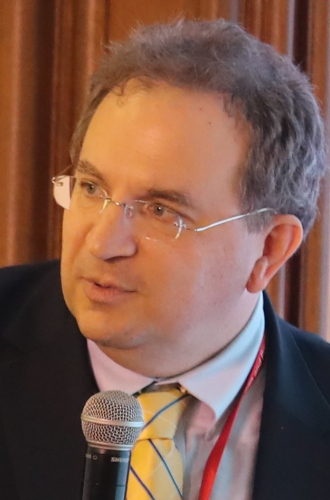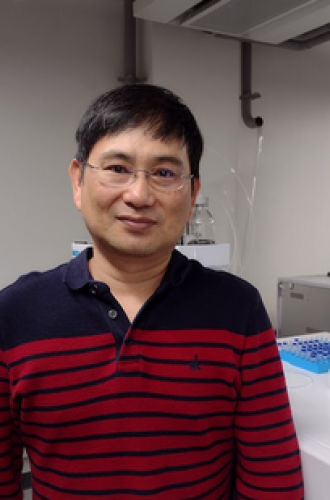

Sun Sun


Department of Chemistry & Biochemistry
The University of Texas at Austin
1 University Station A5300
Austin, TX 78712-0165


Contact Information


Office: WEL: 3.416
Phone: 232-9160

Lab


Office:
Phone:
Fax: 471-8696

Keith J. Stevenson


stevenson@cm.utexas.edu
Associate Professor, Faculty
Fellow, Jack S. Josey Professorship in Energy Studies

Research Group


Stevenson Group

Education


PhD, University of Utah, 1997
BA, University of Puget Sound, 1989

Postdoctoral Fellow, Northwestern University 1997-2000

Awards


SEAC Young Investigator, 2006
CSGS New Scholar Award, 2004
NSF CAREER Award, 2002

Affiliations


IGERT: Atomic and Molecular Imaging; Center for Nano- and Molecular Science and Technology; Texas Materials Institute;

Analytical Chemistry, Electrochemistry and Surface Chemistry


Analytical Chemistry, Electrochemistry and Surface Chemistry

Our research is aimed at understanding and controlling the kinetics and energetics of reactions occurring at scientifically interesting, technologically relevant solid/liquid interfaces. Driving our fundamental interest is the need to comprehend the intricate relationships between mass transport, surface reactivity, and interfacial structure. This information is useful for the design and optimization of superior chemical process technologies associated with the areas of chemical sensing, energy storage/conversion, photonics, microelectronics, and device miniaturization.

Nanostructured Materials for Energy Conversion and Storage

Thrusts in this area focus on the creation and study of new materials with improved chemical, electronic and structural properties for potential applications in catalysis and power source technologies (e.g., fuel cells and batteries). One goal is to prepare high surface area (>100 m2/g) and high porosity (>70 to 99%) materials with tailored composition and nanostructure (e.g., size, shape and orientation). For instance, we have prepared nanocarbons via chemical vapor deposition that are inherently catalytic for oxygen reduction and hydrogen peroxide decomposition. Current studies involve the synergistic tuning of these nanocarbon supports with more active metal catalysts to enhance catalytic performance.

Chemically-Responsive Composites for Analysis and Sensing

Projects in this area are directed toward the assembly of nanostructured materials (mesoporous, colloidal, sorptive or framework solids) and chemical composites (substrate-specific, activator/reporter molecule systems) for use in developing selective chemical sensing methodologies. By employing both conventional and non-conventional nano- and micro-patterning techniques in conjunction with chemical and electrochemical deposition methods, we have been able to fabricate composite assemblies that are useful as 1D and 2D optical transmission gratings in chemical sensing applications. In a separate project, we have utilized the redox activity of small molecules in a mediated, enzymatic electrochemical sensing scheme. This system enables ultra-low (<1 nM); quantitative detection of biogenic analytes (cholesterol, hydrogen peroxide).

Development of High Resolution Analytical Tools/Methods

Projects in this area focus on the development of improved analytical methods and tools for the spatial, temporal, and spectral investigation of materials and interfaces. Better comprehension of mechanistic factors obtained by these measurements allows for direct establishment of structure/composition/performance relationships. For instance, we have recently used spectroelectrochemical imaging schemes to study proton and lithium insertion at inhomogeneous metal oxides (e. g. MoO3, MoxW1-xO3, MnO2,). Information of this kind is useful for developing superior materials for batteries, flexible electronics, electrochromics, and solar cells. We also developed ultra-sharp, nanosized probe tips with controlled geometry and orientation. These probe provide enhanced spatial resolution for characterization of nanoscale, high-aspect ratio features commonly associated with microelectronic devices.


Representative Publications


Lyon, J. L.; Hill, R. T.; Shear, J. B.; Stevenson, K. J. "Direct Electrochemical and Spectroscopic Assessment of Heme Integrity in Multiphoton Photo-Cross-Linked Cytochrome c Structures" Anal. Chem. 79(6) (2007): 2303.

Lyon, J. L.; Stevenson, K. J. "Picomolar Peroxide Detection Using a Chemically Activated Redox Mediator and Square Wave Voltammetry" Anal. Chem. 78(24) (2006): 8518.

Maldonado, S; Morin, S; Stevenson, K. J. "Structure, Composition, and Chemical Reactivity of Carbon Nanotubes by Selective Nitrogen Doping" Carbon 44(8) (2006): 1429.

Kondrachova, L; Hahn, B; Vijayaraghavan, G; Williams, R. D.; Stevenson, K. J. "Cathodic Electrodeposition of Mixed Molybdenum-Tungsten Oxides from Peroxo-Polymolybdotungstate Solutions" Langmuir 22(25) (2006): 10490.

Lee, K. S.; Smith, T. J.; Dickey, K. C.; Yoo, J. E.; Stevenson, K. J.; Loo, L. "High Resolution Characterization of Pentacene-Polyaniline Interfaces in Thin-Film Transistors" Adv. Func. Mater. 16 (2006): 2409.

McEvoy, T. M.; Long J. W.; Smith, T. J.; Stevenson, K. J. "Nanoscale Conductivity Mapping of Hybrid Nanoarchitectures: Ultrathin Poly (o-Phenylenediamine) on Mesoporous Manganese Oxide Ambigels" Langmuir 22(6) (2006): 4462-.